
Chatbots and AI assistants are becoming a new advertising channel in their own right — not just through the large global platforms, but increasingly through publishers building their own assistants too. Analysts already put US AI ad spend alone at $68 billion by 2030 — and that’s before the rest of the world, or every publisher building its own assistant, is counted in.
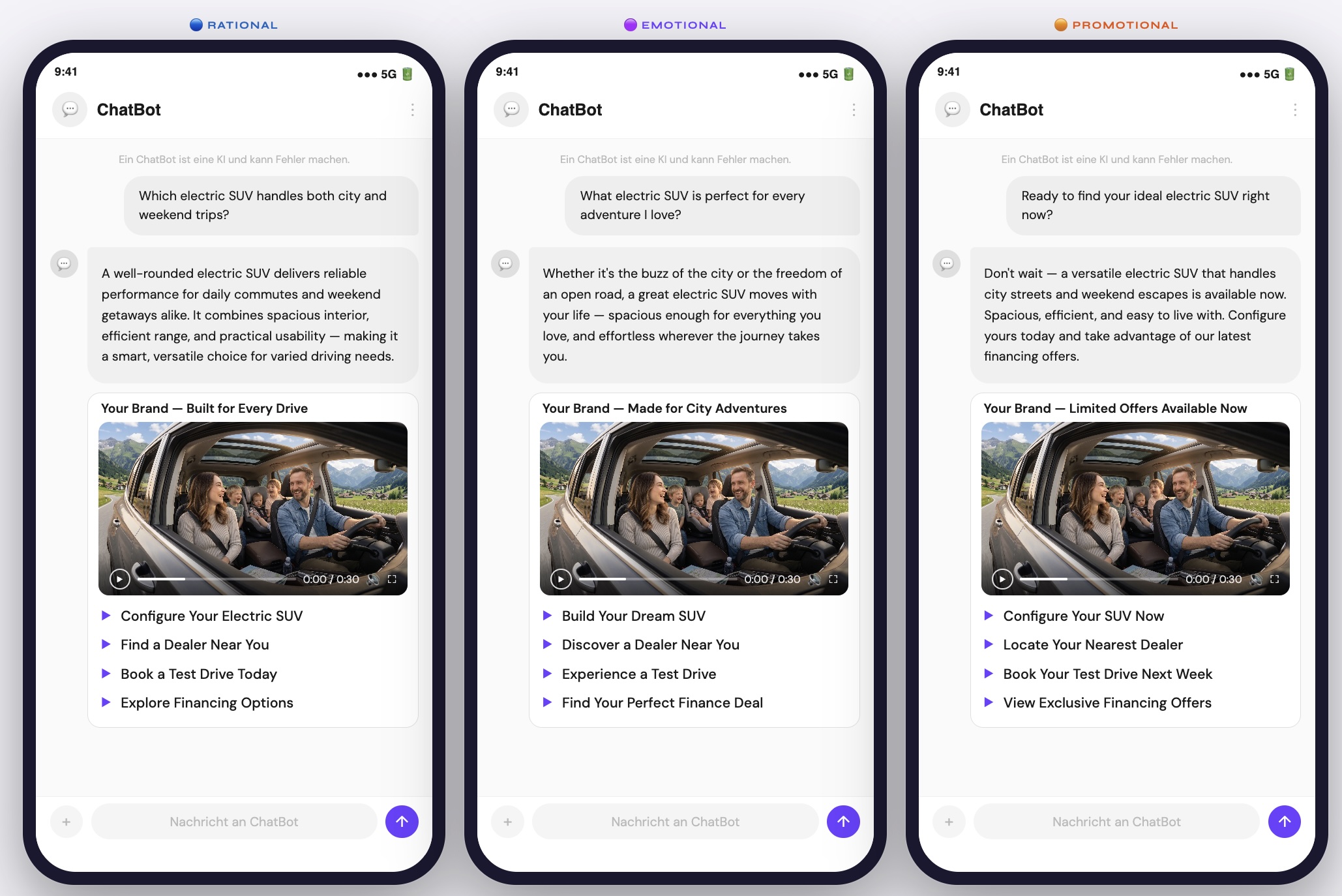
A channel this size comes with its own rules, starting with the most basic one: Imagine a video starting to play on its own inside a chatbot. Users would be gone before you could react — not because the ad was bad, but because it interrupted something they were in the middle of doing. That’s why advertising as a service, built on formats designed for this environment rather than borrowed from the banner era, isn’t optional here. It’s the baseline.
A chatbot is not a shop window — it’s an advisor. When someone asks an AI for help, they’re in a different mindset than when browsing a website. Advertising that interrupts that moment loses trust. Advertising that completes the answer earns it.
Targeting
Deciding which campaign, and which format, gets shown in a given conversation is entirely the chatbot provider’s call. Spoods supplies the format. The provider decides when, where and to whom it’s shown.
Placement
Inside a chatbot, a Spoods creative can appear in the middle of an answer or right below it — exactly where the chatbot provider decides it fits. The format itself can be generated directly within a chatbot provider’s own technology stack, wherever their advertising formats already get built.
Fuel for their own algorithms
Every interaction — a video start, a completed view, a deeplink click — flows back into the chatbot provider’s own systems. It’s real signal for the algorithms that decide which prompts and answers an ad performs well alongside, and how to place it better next time.
Proof, without the data
What the interaction produces — a video start, a completed view, a deeplink click. That signal is also what makes it possible to prove advertising actually worked, without ever handing over user data — exactly the kind of proof advertisers and their media agencies have every right to ask for.
This is the same idea behind Spoods everywhere it runs: advertising that works like a service, not an interruption. Conversational AI is simply the next place that idea belongs.